The University of Tokyo & NTT
A Hard-to-Read Internet That Protects Your Mind
EmoJammer is a research project that modulates typeface legibility of emotionally manipulative social media posts. By making provocative content harder to read, we create a subtle design friction that encourages deliberate thinking — without removing or censoring any content. Our goal is to promote digital well-being by helping users engage with social media more mindfully.
What Changes
EmoJammer detects emotionally manipulative posts and reduces their typeface legibility. Calm, everyday posts remain unchanged.
They've been LYING to us for years and nobody's talking about it!!! This is the biggest coverup I've ever seen. Wake up people, share this before they take it down!!!
Just finished a really good book. Making some tea and thinking about starting another one tonight.
BREAKING: Scientists just confirmed this common ingredient is literally destroying your body from the inside. I'm shaking just reading this. Everyone NEEDS to see this!!!
The weather's nice today so I took the dog for a long walk. Found a quiet spot by the river.
They've been LYING to us for years and nobody's talking about it!!! This is the biggest coverup I've ever seen. Wake up people, share this before they take it down!!!
Just finished a really good book. Making some tea and thinking about starting another one tonight.
BREAKING: Scientists just confirmed this common ingredient is literally destroying your body from the inside. I'm shaking just reading this. Everyone NEEDS to see this!!!
The weather's nice today so I took the dog for a long walk. Found a quiet spot by the river.
How EmoJammer Works
Emotionally manipulative posts — content that deliberately provokes anger, anxiety, or fear — spread rapidly on social media and undermine informed judgment. Traditional moderation approaches like content removal or warning labels have limited effectiveness and risk being perceived as censorship. EmoJammer takes a different approach: instead of removing or labeling content, it reduces typeface legibility to create a subtle design friction that slows impulsive reading while preserving user autonomy.
Fetch Posts
Retrieve the user’s following timeline from Bluesky in real time.
Detect Manipulation
Analyze each post using an LLM to detect emotionally manipulative content — language designed to provoke outrage, fear, or panic.
Typeface Modulation
Apply less legible typefaces to manipulative posts, creating a subtle friction that slows impulsive reading.
Display
Present the modulated timeline in a familiar Bluesky-like interface — content is never hidden or removed.
Research
CHI 2026 Poster
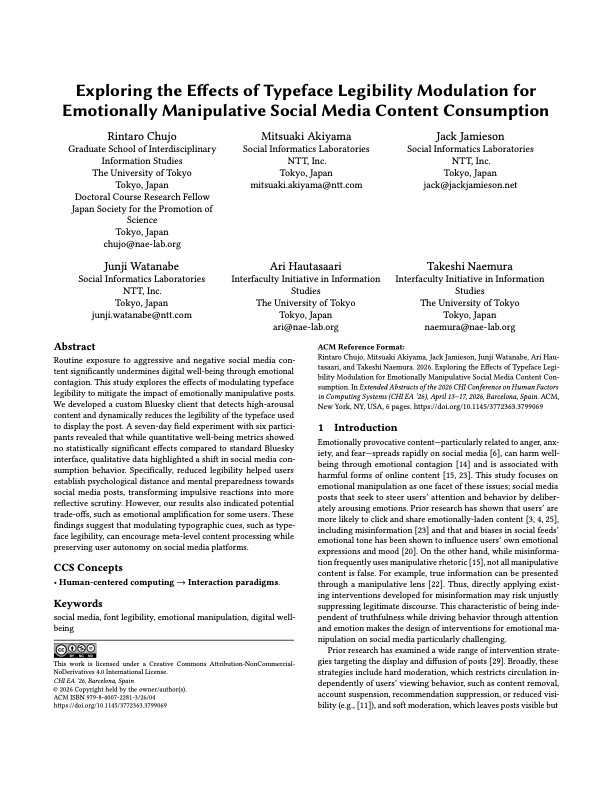
Exploring the Effects of Typeface Legibility Modulation for Emotionally Manipulative Social Media Content Consumption
Rintaro Chujo, Mitsuaki Akiyama, Jack Jamieson, Junji Watanabe, Ari Hautasaari, Takeshi Naemura
The University of Tokyo & NTT, Inc.
We developed a custom Bluesky client that detects high-arousal content and dynamically reduces the legibility of the typeface used to display the post. A seven-day field experiment with six participants revealed that while quantitative well-being metrics showed no statistically significant effects compared to the standard Bluesky interface, qualitative data highlighted a shift in social media consumption behavior.
Read Paper (ACM DL)Citation
Rintaro Chujo, Mitsuaki Akiyama, Jack Jamieson, Junji Watanabe, Ari Hautasaari, and Takeshi Naemura. 2026. Exploring the Effects of Typeface Legibility Modulation for Emotionally Manipulative Social Media Content Consumption. In Proceedings of the Extended Abstracts of the 2026 CHI Conference on Human Factors in Computing Systems (CHI EA ’26). Association for Computing Machinery, New York, NY, USA, Article 282, 1–6.
This study is the result of Sustainable Well-being Social Collaboration Initiative, a joint program between NTT and the University of Tokyo, and the manuscript preparation was partly supported by JSPS KAKENHI Grant Number 25KJ0813.
Exhibition
Sustainable Well-being Exhibition
From a More-than-Human Perspective
EmoJammer is currently on display at this exhibition. Come experience the work in person.
Glass Rock Gallery (Toranomon Hills Station Tower B1F)
March 7 (Sat) – June 13 (Sat), 2026
Weekdays 9:00–22:00 / Sat, Sun & Holidays 10:00–18:00 (Closed on Sun & Holidays from April 1)
Admission Free
Organized by: The University of Tokyo × NTT Sustainable Well-being Social Collaboration Initiative, Mori Building Co., Ltd. Glass Rock
About Us
Sustainable Well-being Social Collaboration Initiative
The Sustainable Well-being Social Collaboration Initiative, established by the University of Tokyo and NTT Corporation, pursues collaborative research and human resource development to explore ways of living better together and sustainably—within natural and artificial environments, as well as the natural and information environments that encompass them. Going beyond human-centered frameworks, we conduct practical research from diverse perspectives including technology and service design, as well as artistic expression, and aim to create a community that transcends the boundaries between academia and industry.
Website